

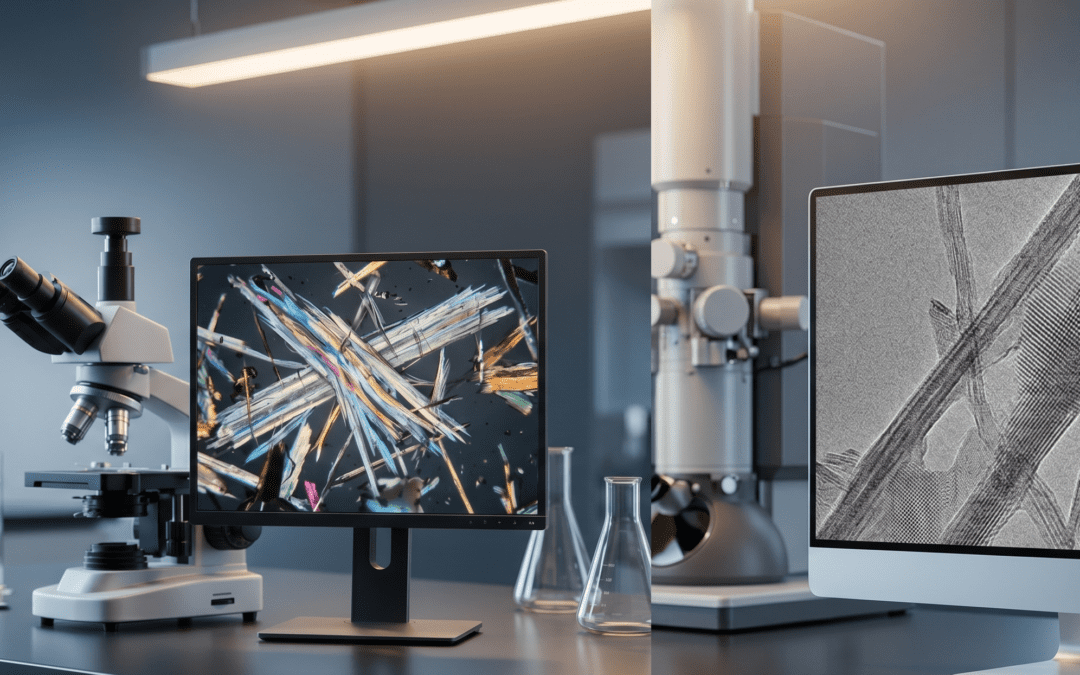
When you send a suspected asbestos sample to a laboratory, the lab does not just look at it and give you a yes or no. They run a specific analytical method to identify whether asbestos fibres are present, which type of asbestos it is, and in some cases, how much of it is in the material.
Most homeowners never think about which testing method is being used. They hand the sample to their inspector, wait for the results, and read the conclusion. But the method matters. Different methods have different levels of accuracy, different detection limits, and different costs. Choosing the wrong method for your situation can give you incomplete or misleading results.
Here is how the main asbestos testing methods work, how they compare, and which one is right for your situation.
How Samples Are Collected
Before any lab analysis happens, a physical sample needs to be collected from the suspect material. This is called bulk sampling, and it is the starting point for all laboratory-based asbestos testing.
A licensed asbestos assessor or inspector takes a small piece of the suspect material, typically a few square centimetres. The sample is cut or carefully broken from the material using tools that minimise fibre release. The assessor wets the area before and after sampling, seals the sample in a labelled bag, and sends it to a NATA-accredited laboratory.
The sampling process itself is straightforward, but it requires care. A poorly collected sample (too small, contaminated by adjacent materials, or taken from the wrong layer of a multi-layer product) can give inaccurate results regardless of how good the lab analysis is.
Multiple samples are often needed from a single property. Different rooms, different materials, and different construction eras can all contain different products. A bathroom wall might be asbestos cement while the kitchen wall is standard plasterboard. Each suspect material needs its own sample.
Polarised Light Microscopy (PLM)
PLM is the most commonly used method for identifying asbestos in bulk building material samples in Australia. It is the standard method for residential and commercial asbestos testing and is referenced in the Australian Standard AS 4964.
How It Works
The laboratory analyst prepares thin sections or crushed fragments of the sample and examines them under a polarised light microscope. Asbestos fibres have distinctive optical properties (birefringence, refractive index, extinction angle, and sign of elongation) that allow them to be identified and distinguished from other fibres.
PLM can identify the three most common types of asbestos found in Australian buildings: chrysotile (white asbestos), amosite (brown asbestos), and crocidolite (blue asbestos). It can also identify the less common types (tremolite, actinolite, and anthophyllite), though these are rarely encountered in residential products.
Strengths
PLM is fast, relatively inexpensive, and well-suited to identifying asbestos in bonded building materials like cement sheeting, floor tiles, and roofing products. Turnaround times are typically one to three business days, with urgent (same-day or next-day) results available at most labs for an additional fee.
It provides a definitive identification of asbestos type and can estimate the approximate proportion of asbestos in the sample (usually expressed as a percentage or range, such as “10 to 15% chrysotile”).
Limitations
PLM has a practical detection limit. If asbestos is present in very low concentrations (typically below about 1% by volume), PLM may not reliably detect it. This is not usually a problem for standard building materials, which tend to contain asbestos in concentrations of 5% to 40%. But for samples like soil, dust, or heavily processed materials, PLM may miss trace amounts.
PLM also requires the analyst to physically find fibres in the prepared sample. If the sample is small or the fibres are unevenly distributed through the material, there is a chance that the specific section examined under the microscope does not contain visible fibres, even though the broader material does. This is why sampling technique and sample size matter.
Dispersion Staining
Dispersion staining is not a separate method but a refinement technique used within PLM analysis. It involves immersing the sample fibres in liquids with known refractive indices and observing the colour effects under specific lighting conditions.
Each asbestos mineral type produces a characteristic colour pattern when immersed in the correct liquid and viewed under central or oblique illumination. This technique increases the confidence of fibre identification, particularly when distinguishing between asbestos and non-asbestos fibres that look similar under standard polarised light.
Most NATA-accredited labs in Australia use dispersion staining as part of their standard PLM analysis for asbestos identification. It is not typically listed as a separate service; it is built into the PLM workflow.
Transmission Electron Microscopy (TEM)
TEM is the most sensitive method available for asbestos analysis. It operates at a much higher magnification than PLM and can detect fibres that are too thin or too small to be seen under a light microscope.
How It Works
The sample is prepared by dissolving the matrix material (cement, resin, soil) and collecting the remaining fibres on a filter. The filter is then examined under a transmission electron microscope, which passes a beam of electrons through the sample to create an image.
TEM can identify individual asbestos fibres based on their morphology (shape), crystallography (internal structure, determined by electron diffraction), and chemical composition (determined by energy-dispersive X-ray spectroscopy, or EDS). This combination of techniques provides the highest level of certainty in fibre identification.
Strengths
TEM can detect asbestos at concentrations well below what PLM can achieve. It is the method of choice for soil analysis, dust wipe analysis, air filter analysis (particularly after loose-fill asbestos removal), and any situation where trace-level detection is needed.
TEM also provides fibre-by-fibre identification, meaning it can confirm both the type and the exact morphology of each fibre detected. This is important for regulatory and legal purposes where precise identification is required.
Limitations
TEM is significantly more expensive than PLM. The equipment is more complex, the sample preparation is more time-consuming, and the analysis requires a higher level of specialist training. Turnaround times are longer, typically three to five business days or more.
For standard building material identification (confirming whether a fibro wall contains asbestos), TEM is overkill. PLM provides reliable results for these materials at a fraction of the cost and time. TEM is reserved for situations where PLM cannot provide a definitive answer or where trace-level detection is required.
Which Method Should You Use
For most residential asbestos testing in Sydney, PLM is the right choice. If you are having a pre-renovation asbestos inspection and the assessor is sampling wall sheeting, roofing, eaves, flooring, or fencing, PLM will give you a reliable result at a reasonable cost.
TEM becomes relevant in specific scenarios. If the PLM result is inconclusive (the analyst could not definitively confirm or rule out asbestos), TEM can provide a more definitive answer. If you are testing soil or dust for asbestos contamination (for example, after a known asbestos product has deteriorated in the yard), TEM is the appropriate method because the asbestos concentration may be too low for PLM. If you are dealing with a loose-fill asbestos situation or need clearance verification after a complex removal, TEM provides the sensitivity needed for those assessments.
Your asbestos assessor should recommend the appropriate method based on the material type and the purpose of the testing. If they default to PLM for everything without considering the specific situation, it is worth asking whether TEM would be more appropriate for any of the samples.
Choosing a Laboratory
Regardless of the method used, the laboratory must be NATA-accredited for asbestos fibre identification. NATA accreditation confirms that the lab operates under a quality management system, uses validated methods, employs qualified analysts, and participates in proficiency testing programs.
Results from a non-accredited lab may not be accepted by regulators, insurers, or buyers during property transactions. Always confirm NATA accreditation before sending samples.
Most licensed asbestos assessors and contractors have established relationships with accredited labs and handle the submission process on your behalf. You should not need to find a lab yourself unless you are conducting DIY sampling (which is permitted for homeowner-initiated testing but is not recommended due to the risk of incorrect sampling technique).
After the Results
Once your test results confirm the presence of asbestos, the next step depends on the type, location, and condition of the material and your renovation plans. In most cases, the material will need to be removed by a licensed contractor before any further work can proceed in the affected area.
After removal and clearance, the spaces where asbestos was present need to be rebuilt. Rosemont Contractors handles the full scope: testing, removal, and carpentry restoration as one project with one team. No handoff to a second contractor. No waiting for availability.
Get Your Property Tested
If you are planning a renovation on a pre-2003 Sydney home, professional asbestos testing is the starting point. Rosemont Contractors provides NATA-certified testing and full-scope removal and restoration across Sydney, the Northern Beaches, Central Coast, and Wollongong. Contact us for a free quote.