

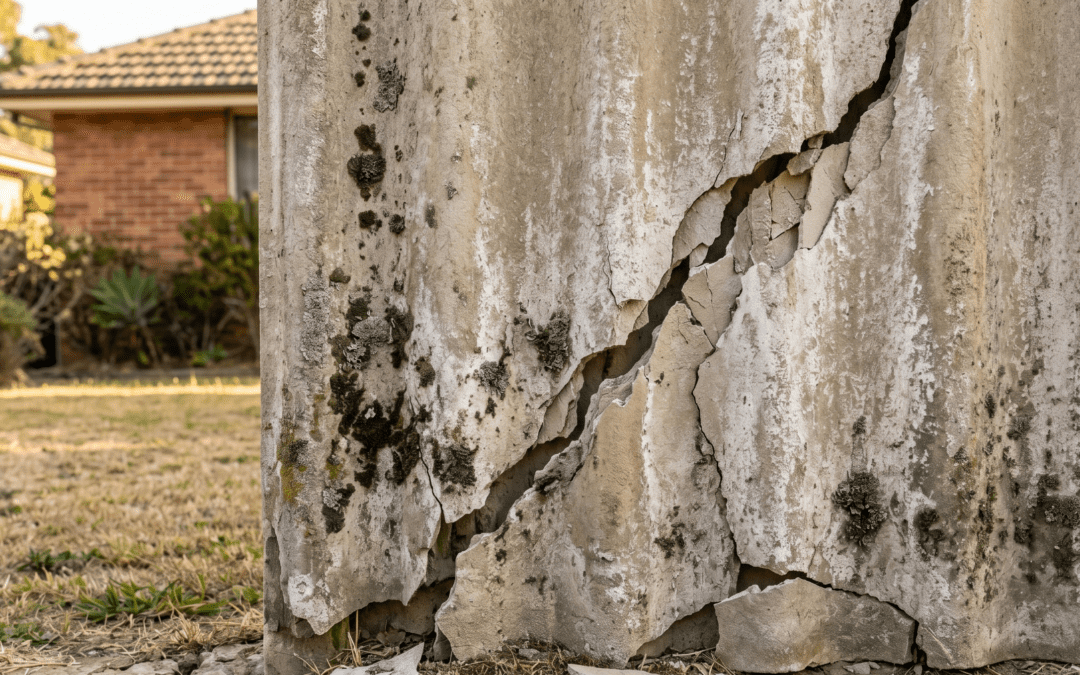
Drive through any suburb in Sydney that was developed between the 1950s and 1980s, and you will see them: flat, grey, cement-sheet fences separating properties. Some are painted. Some are bare. Many are cracked, leaning, and visibly falling apart.
These are fibro fences. And in most cases, fibro means asbestos.
Asbestos cement fencing was one of the most widely used residential products in Australia during the mid-20th century. It was cheap, easy to install, and fire resistant. Builders and homeowners used it everywhere: side fences, back fences, front fences, retaining walls, and garden bed edging.
More than 20 years after Australia banned asbestos, an enormous number of these fences are still standing. And a growing number of them are reaching a condition where they are no longer safely manageable in place.
How Widespread Is the Problem
Exact figures on the number of asbestos fences remaining across Sydney do not exist. No council maintains a comprehensive register of residential asbestos fencing. But the scope can be estimated from the housing data.
Suburbs that experienced large-scale residential development between the 1950s and 1980s are the most likely to have asbestos fencing still in place. That includes large swathes of Western Sydney (Fairfield, Bankstown, Penrith, Campbelltown), parts of the Inner West (Ashfield, Strathfield, Burwood), and pockets of the Northern Beaches, North Shore, and Southern Sydney.
In many of these suburbs, the original dividing fences were installed at the same time as the houses. If the house was built in 1965 and the fences have never been replaced, those fences are now over 60 years old. Asbestos cement products were never designed to last that long without maintenance or replacement.
Why Old Fibro Fences Are a Growing Risk
When asbestos cement fencing is in good condition, it poses a low risk. The asbestos fibres are locked within the cement matrix and are not released into the air. A well-maintained, painted, undamaged fibro fence is considered stable.
The problem is that very few 50-to-70-year-old fibro fences are still in good condition. Decades of sun exposure, rain, wind, ground movement, and physical impacts take their toll. The signs of deterioration are visible across Sydney’s older suburbs.
Surface Degradation
UV exposure and weathering break down the cement binder over time. The surface becomes chalky, powdery, and rough. This is called “fretting,” and it is the early stage of fibre release. Running your hand along a fretted fibro surface can leave a white, powdery residue on your skin. That residue may contain asbestos fibres.
Cracking and Breaking
Ground movement, tree root pressure, and physical impacts (lawnmowers, balls, leaning objects) cause cracks and breaks in fibro fencing. Each crack exposes the internal matrix of the material, where fibres are more accessible. Broken pieces lying on the ground are even more problematic: foot traffic, lawn mowing, and rain can all release fibres from broken fragments.
Moss, Lichen, and Moisture
In shaded areas, moss and lichen growth is common on fibro fences. While the growth itself is not dangerous, removing it (scrubbing, pressure washing, scraping) disturbs the surface and releases fibres. Persistent moisture also accelerates the breakdown of the cement binder, making the material more prone to crumbling.
Leaning and Collapse
Fibro fence panels are brittle. When posts rot or ground conditions shift, panels lean, bow, and eventually fall. A falling fibro panel can shatter on impact, releasing a burst of fibre-containing dust and leaving sharp, broken pieces on the ground. This is particularly dangerous in properties where children or pets use the yard.
The Neighbour Problem
Fencing in NSW is governed by the Dividing Fences Act 1991. Under this Act, the cost of a dividing fence is generally shared equally between the two property owners. This creates a complication when one owner wants to replace an asbestos fence and the other does not.
If you want to replace your fibro dividing fence, you are typically required to give your neighbour written notice and negotiate the cost. If your neighbour refuses to contribute, you may need to apply to the local court or the NSW Civil and Administrative Tribunal (NCAT) for a fencing order.
The asbestos component adds another layer. If the fence is in deteriorating condition and poses a health risk, a stronger case can be made for replacement. Some councils also have provisions for dangerous or hazardous fencing that may support a replacement claim.
The practical reality is that many asbestos fences stay in place because neighbours cannot agree on cost sharing. The fence continues to deteriorate while both parties wait for the other to act.
Council Rules and DIY Limitations
Each local council in Sydney has its own approach to asbestos fencing. Some councils accept asbestos fencing at their waste facilities (with restrictions). Others direct residents to licensed contractors.
Under NSW regulations, a homeowner can remove up to 10 square metres of non-friable asbestos from their own property without a licence. But a dividing fence is shared property. Removing a shared fence without proper notice to your neighbour can create legal issues under the Dividing Fences Act.
Even if the 10 square metre DIY threshold applies, a full dividing fence on one side of a standard residential block can easily exceed that limit. A fence running 15 metres at 1.8 metres high is 27 square metres on one side alone. That is well beyond the DIY limit.
For most fence replacement projects, a licensed asbestos removal contractor is the practical and legal path forward. The contractor handles the safe removal, waste packaging, transport, and disposal at a licensed facility.
What Replacement Looks Like
Replacing an asbestos fence is a two-stage process: removal of the old fence, then installation of the new one.
The removal stage involves carefully dismantling the fibro panels without breaking them (to minimise fibre release), wetting the material, wrapping it in heavy-duty plastic, and transporting it to a licensed waste facility. Posts may also need to be removed, depending on their condition and the design of the new fence.
The installation stage involves new posts, rails, and cladding. Common replacement materials include colorbond steel, timber, and composite panels. The choice depends on budget, street presentation requirements (if it is a front fence), and the style of the property.
After the asbestos panels are removed, any post holes or ground areas that were in contact with the old fence should be inspected for debris. Broken fragments buried at the base of the fence are common and need to be collected and disposed of as asbestos waste.
The Cost Factor
Replacing an asbestos fence costs more than replacing a standard fence because of the removal, containment, and disposal requirements. The asbestos removal component adds a layer of cost on top of the normal fencing installation price.
However, putting off replacement does not make it cheaper. As the fence deteriorates further, the removal becomes more complex (broken and crumbling material is harder to handle safely than intact panels). And a collapsing fence that scatters broken fibro across your yard can trigger a contamination cleanup that costs far more than a planned replacement.
The proactive approach, which involves removing the fence while it is still relatively intact, is almost always less expensive than dealing with a collapse or a deterioration crisis.
The Connection to Broader Renovation Work
Many homeowners discover their asbestos fencing problem during a broader renovation project. They are extending the house, landscaping the yard, or building a new garage, and the old fibro fence is in the way.
This is often the most efficient time to deal with the fence. If you already have an asbestos removal contractor on site for interior work (wall sheeting, eaves, roofing), adding the fence to the scope is usually more cost-effective than running a separate job later. The setup costs, transport, and disposal are already covered.
Rosemont Contractors handles asbestos removal across all material types, including fencing, as part of our broader scope. And because we also hold a carpentry licence (398318C), we can manage the restoration and rebuilding work that follows removal, whether that is new wall sheeting inside the house or new fence rails outside.
Do Not Wait for the Fence to Fall
If your property has fibro fencing that is visibly deteriorating, cracking, or leaning, the safest time to deal with it is now, while the panels are still intact and can be removed in whole sheets. Rosemont Contractors provides asbestos fence removal and disposal across Sydney, the Northern Beaches, Central Coast, and Wollongong. Contact us for a free quote.