

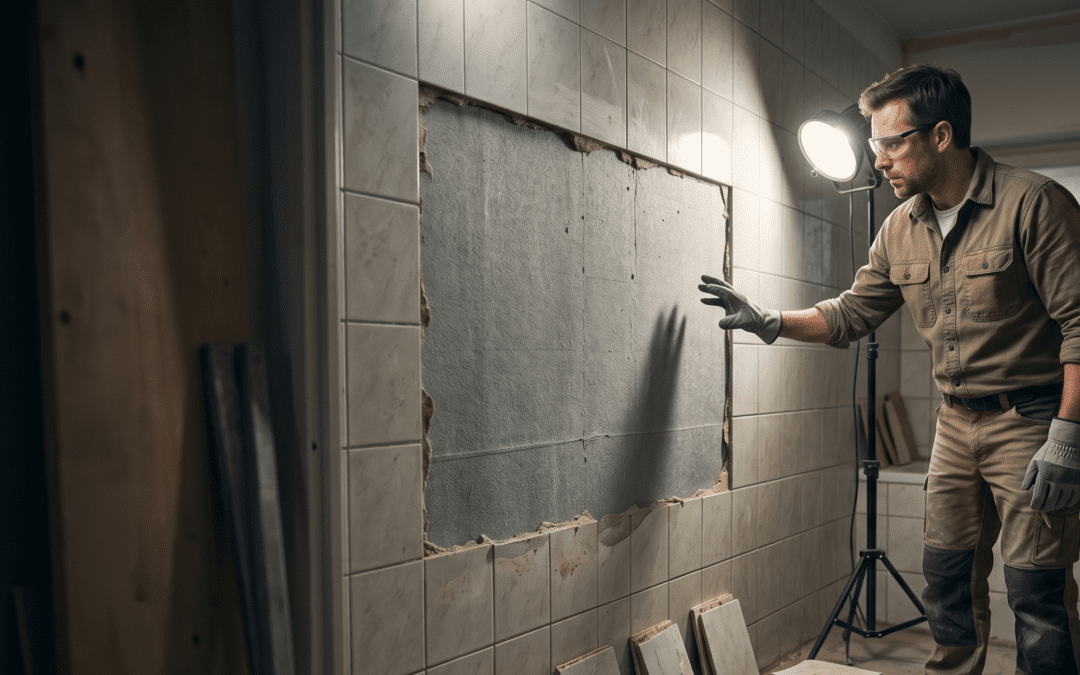
You are three days into a bathroom renovation. The tiler has pulled the old tiles off the walls, and behind them is a layer of flat grey sheeting that looks different from plasterboard. Your builder stops, takes a step back, and says the words no homeowner wants to hear: “That could be asbestos.”
This scenario plays out across Sydney every week. Despite two decades of public awareness campaigns, asbestos discoveries during active renovation work remain one of the most common exposure events in residential settings. The home was built in the 1970s, the walls looked fine from the outside, and nobody thought to check what was behind the tiles.
What you do in the next 30 minutes matters more than anything else in the project. Here is the response plan, step by step.
Step 1: Stop All Work Immediately
The moment anyone suspects asbestos, all work in the affected area must stop. No more cutting, drilling, sanding, hammering, or demolition. Put down the tools.
This is not a “finish the section and then stop” situation. Every additional cut, impact, or disturbance releases more fibres into the air. The damage is cumulative. Stopping immediately limits the total amount of fibre release.
If power tools were being used (angle grinders, circular saws, reciprocating saws), turn them off and leave them where they are. Moving contaminated tools through the house spreads fibres to clean areas.
Step 2: Clear the Area
Everyone who is not wearing proper respiratory protection (a P2 half-face respirator at minimum) should leave the room immediately. That includes the builder, any tradies, family members, and pets.
Close the door to the room if possible. If there is no door, hang a sheet of plastic over the opening to limit airflow from the affected area into the rest of the house. Open windows in the affected room to allow ventilation to the outside, but close windows and doors in the rest of the house to prevent fibres migrating to other rooms.
Do not sweep, vacuum (unless using a HEPA-filtered vacuum), or wipe down surfaces in the affected area. Standard brooms and household vacuums do not capture asbestos fibres. They redistribute them into the air at face height.
Step 3: Do Not Try to Identify the Material Yourself
You cannot confirm whether a material contains asbestos by looking at it, touching it, or breaking a piece off. Asbestos cement sheeting looks identical to non-asbestos cement sheeting. The only way to confirm is laboratory analysis of a physical sample.
Do not break, scrape, or cut a piece off to “check.” Every disturbance releases more fibres. Leave the material exactly as it is and call a professional.
Step 4: Call a Licensed Asbestos Assessor or Contractor
Contact a licensed asbestos contractor or assessor to attend the site, take samples, and send them to a NATA-accredited laboratory for testing. Sample results typically take one to three business days, depending on the lab and whether you request urgent turnaround.
When calling, explain that the material was discovered during active renovation work and has been partially disturbed. This gives the assessor context on the urgency and the potential contamination scope.
If you already have a relationship with an asbestos removal contractor, call them directly. Many licensed contractors, including Rosemont Contractors, provide inspection, testing, removal, and restoration as a single scope. Getting the right contractor involved early avoids the delay of coordinating multiple parties later.
Step 5: Notify Your Builder
If you have a builder or project manager overseeing the renovation, notify them immediately. Under the Work Health and Safety Regulation 2017, a person conducting a business or undertaking (PCBU) has a duty to manage asbestos risks on any worksite they control. Your builder needs to know about the discovery so they can manage their own WHS obligations.
A responsible builder will stop all related work, secure the area, and wait for the testing results before proceeding. If your builder suggests “just keep going, it’s probably fine,” that is a serious red flag about their approach to safety and compliance.
Step 6: Manage the Waiting Period
While you wait for test results, the affected area should remain closed off. Nobody enters without a P2 respirator. No work happens in or adjacent to the area.
Use this time to review your renovation plans. If the material is confirmed as asbestos, the removal will need to happen before any further work in that area. Depending on the scope, this could add days or weeks to your project timeline.
Start thinking about the downstream effects. If asbestos is found in the bathroom walls, the tiler cannot continue until the material is removed and a clearance certificate is issued. If asbestos is in the flooring, the floor installer is on hold. If it is in the ceiling, anything above needs to wait.
Step 7: Review the Test Results
When the lab results come back, there are two outcomes.
If the material does not contain asbestos, work can resume. Keep the test report for your records. It is good practice to have documentation confirming that suspect materials were tested and cleared, particularly if you plan to sell the property in the future.
If the material does contain asbestos, you need a licensed removal contractor. The scope of removal depends on how much asbestos-containing material is present and how much of it will be disturbed by the remaining renovation work.
In some cases, only the material in the direct renovation zone needs to be removed. In others, the discovery reveals a broader asbestos presence throughout the home that requires a more complete removal scope. A full asbestos inspection at this stage is worth the investment, because discovering additional asbestos mid-project again later is even more disruptive.
Step 8: Get the Removal Done
A licensed asbestos removal contractor will assess the scope, provide a quote, and schedule the removal. The work involves containment, safe removal using wet methods, waste wrapping and labelling, transport to a licensed disposal facility, and an independent clearance inspection.
Once the clearance certificate is issued, the renovation can resume. The area where asbestos was removed will be stripped back to framing, which means new wall sheeting, ceiling panels, or flooring substrate needs to be installed before the trades (tiler, plasterer, painter) can return.
This is the point where projects lose the most time. The removalist finishes, but the area needs carpentry work before anyone else can continue. If you are using a separate removal contractor and a separate carpenter, you are coordinating two schedules, two quotes, and a handoff in between.
Rosemont Contractors handles both sides. We are licensed for asbestos removal (AD213403) and hold a carpentry licence (398318C) for the restoration work that follows. Our team removes the asbestos, coordinates the clearance, and then installs the replacement materials so your trades can get back to work as quickly as possible.
Step 9: Notify Your Insurer
If the asbestos discovery triggers significant additional costs or delays, check your home insurance policy. Some policies cover asbestos-related costs in specific circumstances (storm damage, fire damage, or accidental discovery during covered work). Others explicitly exclude asbestos.
Contact your insurer early to understand what is covered before you commit to the full scope of work. Keep all test reports, removal quotes, clearance certificates, and invoices as documentation for any potential claim.
How to Avoid This Scenario Entirely
The mid-renovation asbestos discovery is almost always preventable. A pre-renovation asbestos inspection, conducted before any work begins, identifies suspect materials and confirms their status through laboratory testing. The cost of an inspection is a fraction of the cost of a mid-project shutdown.
If you are planning any renovation work on a Sydney home built before 2003, get the inspection done first. It takes a few hours, the results come back in days, and it gives you a clear picture of what you are working with before the first wall comes down.
Get Ahead of the Problem
Do not wait until your builder finds something unexpected. Rosemont Contractors provides pre-renovation asbestos inspections, testing, removal, and carpentry restoration across Sydney, the Northern Beaches, Central Coast, and Wollongong. Contact us for a free quote.