

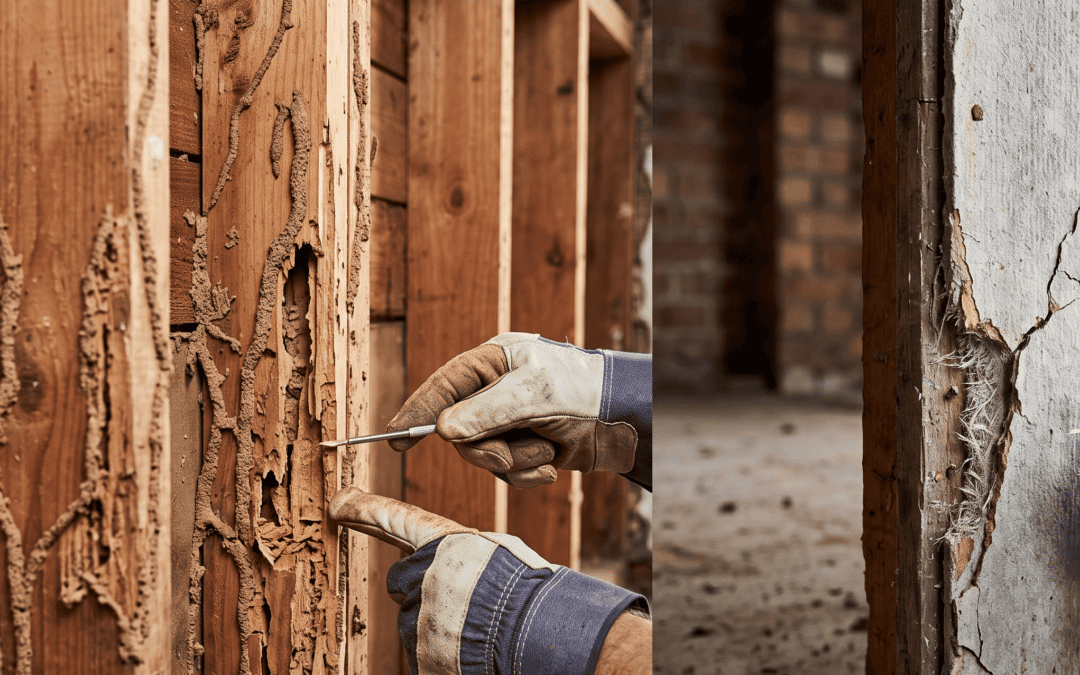
When something looks wrong with a wall, ceiling, or subfloor in an older Sydney home, the cause is not always obvious. A soft, spongy section of skirting board might be termites. A crumbling panel behind the bathroom tiles might be degraded asbestos. A sagging ceiling in the garage could be either, or both.
Termites and asbestos are two of the most common hidden problems in Sydney homes built before the 1980s. They affect different materials in different ways, but they can coexist in the same property, and they sometimes look similar to an untrained eye. Mistaking one for the other, or failing to identify that both are present, can lead to costly mistakes during a renovation.
This guide covers how to visually distinguish between the two, why they often appear together, and what the remediation process looks like when both problems are in play.
Where Termites and Asbestos Overlap
Termites eat timber. Asbestos is a mineral fibre embedded in cement or other binders. On the surface, these are completely different problems affecting completely different materials. But in older Sydney homes, they frequently appear in the same locations.
The reason is construction method. In homes built from the 1940s through the 1980s, timber framing was the structural skeleton and asbestos cement sheeting was the skin. The studs, plates, rafters, and joists were timber. The wall cladding, ceiling sheets, eaves, and sometimes flooring were asbestos cement.
When termites attack the timber framing behind asbestos cement walls, the first visible sign is often a change in the wall surface: bulging, cracking, or soft spots that feel different when tapped. But the homeowner sees the asbestos cement sheet, not the timber behind it, and may assume the problem is with the sheeting rather than the structure.
Conversely, when asbestos cement sheeting deteriorates due to age and moisture, the gaps and cracks that develop can allow moisture into the wall cavity, creating conditions that attract termites to the timber framing inside.
The two problems feed each other. Degraded asbestos lets moisture in. Moisture attracts termites. Termites weaken the framing. Weakened framing causes movement that cracks the asbestos sheeting further. The cycle continues until something gives.
Visual Identification: What to Look For
While professional inspection is always recommended, understanding the visual differences can help you identify potential problems early.
Signs of Termite Damage
Termite damage primarily affects timber and timber-based products. The signs include hollow-sounding timber when tapped (termites eat the inside of the timber while leaving the outer shell intact), mud tubes on foundations, walls, or framing (subterranean termites build these tubes as protected travel routes between their colony and the food source), soft or spongy sections in skirting boards, door frames, window frames, or structural timber, blistering or bubbling paint on timber surfaces (termites sometimes feed just below the paint layer, creating a blistered appearance), and sagging floors, doors that stick, or walls that are no longer plumb (these indicate structural timber damage).
Termite damage is progressive. It gets worse over time as the colony grows and consumes more timber. Early detection and treatment are critical.
Signs of Asbestos Deterioration
Asbestos cement sheeting deterioration is driven by age, weather exposure, and physical impacts. The signs include surface chalking or powdering (the cement binder breaks down, leaving a chalky residue on the surface), cracking, chipping, or breaking at edges and corners, water staining or discolouration (indicating moisture is penetrating the material), moss, lichen, or algae growth on exterior surfaces (indicates persistent moisture exposure), and visible delamination (layers of the material separating).
Deteriorated asbestos is a health risk because the breakdown of the cement binder releases fibres from the material. A sheet that was safely non-friable when installed can become functionally friable after decades of weathering.
When Both Are Present
If you see signs of both termite damage (hollow timber, mud tubes, soft spots in framing) and asbestos deterioration (crumbling sheeting, chalking surfaces) in the same area, both problems need to be addressed. Treating the termites but leaving degraded asbestos in place does not solve the health risk. Removing the asbestos but ignoring the termite-damaged framing leaves a structural problem that will affect the restoration.
Why Professional Inspection Matters
The visual signs described above are indicators, not diagnoses. Confirming whether a material contains asbestos requires laboratory testing. Confirming the extent of termite damage requires a qualified timber pest inspector using moisture meters, thermal imaging, and sometimes borescope cameras to see inside wall cavities.
For pre-renovation assessments on older Sydney homes, getting both an asbestos inspection and a timber pest inspection before work begins is the safest approach. The two inspections serve different purposes and are conducted by different specialists, but the information from both feeds into your renovation plan.
If asbestos is found, a licensed removal contractor handles the extraction. If termites are found, a licensed pest control operator handles the treatment. If both are present (which is common in homes from this era), the asbestos removal typically happens first because the asbestos sheets need to come off the walls before the framing behind them can be fully assessed and treated.
The Combined Remediation Process
When both asbestos and termite damage are present, the remediation follows a specific order.
Phase 1: Asbestos Assessment and Removal
The asbestos-containing materials are identified, tested, and removed by a licensed contractor. During removal, the team exposes the timber framing behind the sheeting. This is often the first time the full extent of any termite damage becomes visible.
A professional removal team will note and document the framing condition during this phase, even though framing repair is not part of the asbestos removal scope. This information is critical for planning the restoration work that follows.
Phase 2: Termite Treatment
Once the asbestos sheets are removed and the framing is exposed, a timber pest specialist can assess the full extent of termite damage and apply treatment. This may include chemical barrier treatment to the soil around the home, direct treatment of affected timber, installation of monitoring stations, and baiting systems for active colonies.
The treatment needs to happen before the new wall sheeting goes up, because the sheeting will conceal the framing again. Treating termites after the walls are re-clad means the pest controller cannot see or access the framing.
Phase 3: Structural Repair
Termite-damaged framing that has lost structural integrity needs to be repaired or replaced. This is carpentry work: sistering new timber alongside damaged studs, replacing destroyed plates or lintels, reinforcing weakened joists or rafters.
The scope of structural repair can range from minor (a few affected studs in one wall) to extensive (full reframing of a section of the home). The assessment during Phase 1 gives a preliminary picture, but the pest inspector’s report in Phase 2 confirms the full extent.
Phase 4: Restoration
With the asbestos removed, the termites treated, and the framing repaired, the home is ready for new wall sheeting, ceiling lining, eaves, and finishing. This is the carpentry restoration phase: installing new materials, jointing, sanding, and preparing surfaces for paint or tile.
Why One Contractor for Asbestos and Carpentry Matters
This four-phase process involves asbestos removal (Phase 1), pest treatment (Phase 2, handled by a pest specialist), structural carpentry (Phase 3), and finishing carpentry (Phase 4). Phases 1, 3, and 4 are all within Rosemont Contractors’ scope.
Because our team handles the asbestos removal and sees the framing condition firsthand, we can assess structural damage early and plan the carpentry restoration accordingly. There is no gap between removal and rebuild. There is no miscommunication between a removal contractor who saw the framing and a carpenter who did not.
We coordinate with your pest control specialist for Phase 2, then step back in for Phases 3 and 4. One team for the building work, with the pest treatment slotted into the sequence at the right time.
This matters because projects that involve both asbestos and termites are the ones most likely to stall when multiple contractors are managing their own scopes independently. The removalist finishes and leaves. The pest controller treats. Then the carpenter arrives, sees damage they were not told about, and the scope expands. With one team handling the building work across all three building phases, these surprises are caught early and planned for.
Get a Full Assessment
If your older Sydney home shows signs of both asbestos and termite damage, start with a professional inspection before you start any renovation work. Rosemont Contractors provides asbestos inspections and full removal-to-restoration services across Sydney, the Northern Beaches, Central Coast, and Wollongong. Contact us for a free quote.