
Can you identify asbestos just by looking at it?
If you are wondering how to identify asbestos in your home, the honest answer is that you cannot do it by eye. Asbestos NSW is blunt about it: you can’t tell if a material contains asbestos just by looking at it. What you can do is work out which materials are likely to contain it, treat those with care, and get the suspect ones tested.
The fibres themselves are invisible. They are 50 to 200 times thinner than a human hair, and they have no smell or taste. Raw asbestos can be blue, brown, green or white, but once it has been mixed into cement, vinyl, adhesive or textured coatings and then painted over, the colour tells you nothing.
The harder problem is that asbestos products look like their modern replacements. The national Asbestos Product Guide notes that casual observation cannot usually tell old asbestos cement sheeting from modern fibre cement board once both are installed, and the word “fibro” is used for both. If fibro is your main concern, our guide on how to tell whether fibro sheeting contains asbestos covers that material in detail.
So identification is really a process of narrowing down: the age of the building, where the material is, what kind of material it is, and finally a laboratory result.
Start with the age of the building
The age of the building is the most useful clue you have. Asbestos NSW says that if your property was built or renovated before 1990, it probably has asbestos-containing materials, and that between 1940 and 1990 asbestos was a popular construction material for Australian homes. If the home was renovated between 1990 and 2004, it may contain asbestos.
Those dates come from how asbestos left the market. James Hardie, by then the only Australian maker of asbestos cement products, stopped using asbestos in its building products in the mid-1980s, but stock already supplied kept being sold and installed. That is why the national product guide treats “prior to 1990” as its cut-off. The total ban on all asbestos came later, on 31 December 2003.
Think about the age of each part of the house, not just the year on the title. A 1960s house with a 1990s extension can have asbestos in the original rooms and none in the new ones. Original bathrooms, laundries, eaves and garages are worth particular attention, because they are the parts most likely to still carry their first materials.
Commercial buildings have their own rule. In NSW, a commercial building built before 2004 must have an asbestos register that records any suspected or assumed asbestos, where it is and what condition it is in. If you work on or lease one, ask for the register before any work starts.
Where to look in an older home
Asbestos NSW lists roofing, ceilings and internal walls, eaves, fencing, flue and water pipes, fireplaces, the backing behind tiles and flooring underlay as the places it is most often found. In practice it helps to go through the house in three parts.
Outside the house
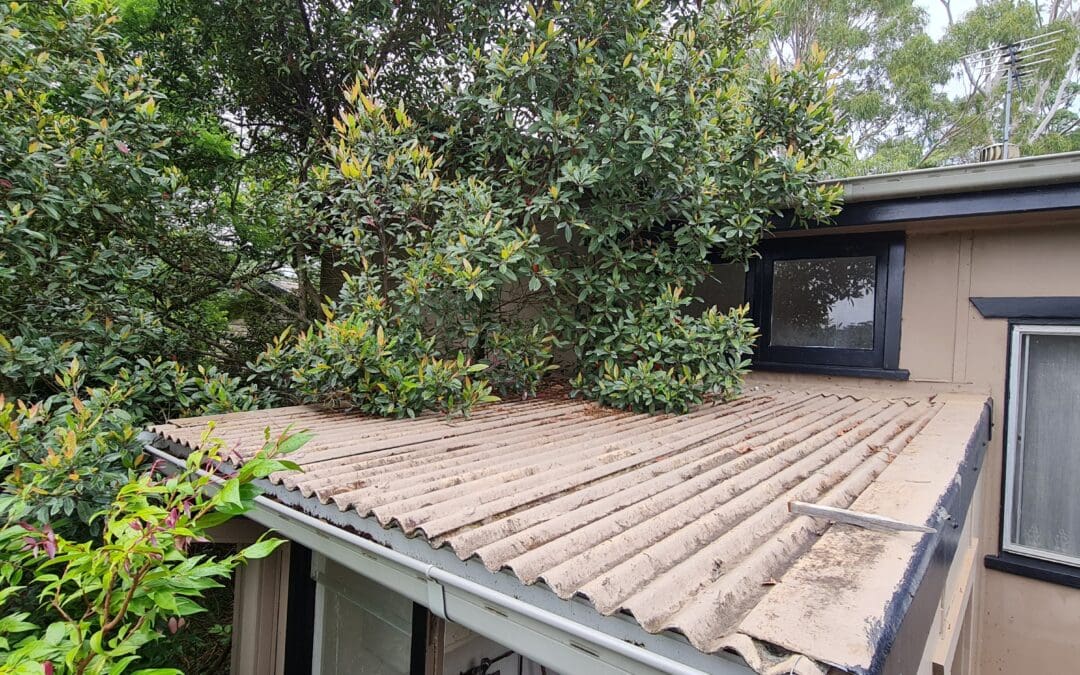
Start with corrugated roof sheeting, flat sheeting under the eaves, external wall cladding and boundary fences made of sheets bolted between posts. Sheds, garages and other outbuildings from the same era often used the same materials. Flue pipes and old fireplaces are worth a look too.
Inside the house
In homes built between the 1940s and 1980s, asbestos cement sheeting was commonly used as a water-resistant backing board behind tiles in bathrooms, kitchens and laundries. Vinyl floor tiles made before the mid-1980s often contained asbestos, and the black adhesive under them can as well. Older electrical meter boards often have asbestos cement backing, and some textured or decorative ceiling coatings applied before the mid-1980s contain it. We cover these and other easily missed spots in our article on places asbestos hides in Sydney homes.
In the roof space and under the floor
Look for flooring underlay and pipe lagging, and check the ceiling cavity for loose, fluffy fibre sitting between the joists rather than batts. That is the pattern of loose-fill asbestos insulation, the product known as Mr Fluffy. Dust and debris in the roof cavity of an older home can also carry asbestos fibres from deteriorating materials.
Clues that make a material more suspect
Some materials carry a warning label that reads WARNING: CONTAINS ASBESTOS. If you find one, you have your answer. But Asbestos NSW points out that just because there is no label, it doesn’t mean there is no asbestos.
Product names can help but they are not proof. The national Asbestos Product Guide lists the asbestos products made and sold in Australia, including well-known sheeting names such as Fibrolite, Super-Six and Hardiflex. It also notes that some of those market names were kept by later manufacturers for products now made with asbestos-free materials. A familiar brand on an old sheet is a reason to be careful, not a confirmation either way.
It also helps to know the difference between the two kinds of asbestos material. Bonded, or non-friable, asbestos has its fibres locked into cement or adhesive. It is the most common type and includes asbestos cement roofing, walls, eaves, fences and pipes, as well as textured paint. Friable asbestos is loosely bound and can be crumbled by hand. It was mostly used for fireproofing and insulation, and it is extremely hazardous because the fibres are released so easily. If a suspect material is soft, powdery or crumbles when touched, leave it completely alone.
Condition matters too. Cracked, broken, weathered or flaking material is not more likely to be asbestos, but if it is asbestos, damaged material is far more likely to release fibres.
How to identify asbestos for certain
The only way to know for sure is a laboratory test. In the words of Asbestos NSW, identifying asbestos requires testing by a licensed asbestos lab, and if you are in doubt, treat the material as if it is asbestos until you know otherwise.
Asbestos testing is how you settle it. Rosemont’s licensed team collects material samples from your property with as little disturbance as possible and sends them to a NATA accredited laboratory. The lab analyses them using methods including stereomicroscopy, polarised light microscopy and dispersion staining, and its report sets out the fibre types found, a description of each material and a clear conclusion. The report is yours to use however you need, whether or not you go ahead with us for any removal work.
If you suspect asbestos in several places across the property, you may need a full property report rather than a single sample test. A whole-property asbestos inspection checks the property for likely asbestos materials, collects samples for NATA accredited lab testing and gives you a detailed report to plan your next steps from, whether that is renovating, buying or simply knowing what you live with.
What to do while you wait for a result
Until a result comes back, follow the Asbestos NSW golden rule: if you think it might be asbestos, treat it like it is. Do not sand, scrub, water-blast, cut or drill the material, and do not try to break off a piece to look at it more closely.
If the material is in good condition and you are not planning any work, there is no need to panic. Asbestos NSW says materials containing asbestos are low risk if they are in good condition and unlikely to be damaged.
If you have found something that is already damaged, Asbestos NSW recommends a few simple steps. Move people away from the area, put on protective equipment, dampen the area, cover it with a tarp or plastic sealed so no dust can escape, and keep people out until a licensed asbestos assessor can advise on what to do next. NSW also recommends that you don’t remove asbestos yourself.
Not sure whether something in your home is asbestos? Call us on 0475 000 021 or request a free quote for testing. We respond to all enquiries within 24 hours.