

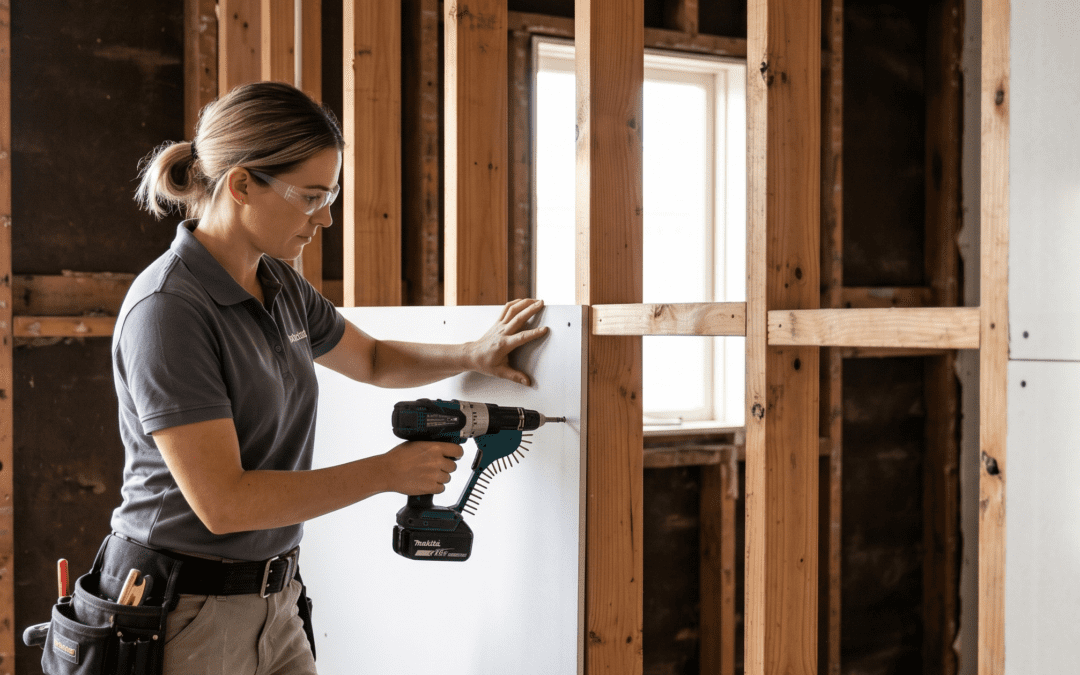
The asbestos removal is done. The clearance certificate is in hand. You walk back into the room and find bare timber framing, exposed wall cavities, and dangling wires where the sheeting used to be.
This is the part of the project that nobody warns you about.
Every asbestos removal guide focuses on the removal itself: the testing, the contractor, the containment, the disposal. What almost none of them mention is what happens next. The removal is only half the job. The other half is putting your home back together.
And for most Sydney homeowners, this restoration phase is where the project stalls, the budget blows out, and the frustration peaks. Because the asbestos removalist has packed up and left, and now you need an entirely different contractor to finish the work.
Why Restoration Gets Ignored
The asbestos removal industry and the carpentry trade operate as separate businesses. Removalists specialise in safe extraction and disposal. Carpenters specialise in building and finishing. The two skill sets overlap in one critical area, which is the moment between the asbestos coming off the wall and the new material going on, and almost nobody covers that gap.
When a homeowner gets a quote for asbestos removal, the quote covers everything up to and including the clearance certificate. It does not include replacing the wall sheeting, re-lining the ceiling, installing new eaves, or finishing and painting the surfaces. Those costs are additional, and they often match or exceed the removal cost itself.
The result is a two-contractor project where the homeowner is stuck in the middle, managing timelines, coordinating handoffs, and paying for two separate mobilisations. The removalist finishes on a Tuesday, the carpenter cannot start until the following Monday, and you spend a week living with a hole in your bathroom wall.
What Restoration Involves
The scope of restoration depends on what was removed. Here are the most common scenarios and what the rebuild typically includes.
Wall Sheeting Replacement
When asbestos cement wall sheeting is removed from bathrooms, laundries, garages, or internal rooms, the replacement involves installing new sheeting to the exposed framing. The most common replacement materials are villaboard (fibre cement board designed for wet areas), standard plasterboard (for dry areas), and fibre cement cladding (for external walls).
The work includes measuring and cutting the new sheets to fit, fixing them to the framing with appropriate fasteners, taping and setting the joints, and preparing the surface for the final finish (tiles, paint, or render).
For wet areas like bathrooms and laundries, waterproofing is required before tiling. The waterproofing membrane must be applied to the new sheeting and allowed to cure before the tiler can start. This adds time and cost to the restoration.
Ceiling Replacement
Asbestos cement ceiling sheets are common in older Sydney homes, particularly in garages, verandahs, and utility rooms. After removal, the ceiling needs new sheeting (typically plasterboard or fibre cement), jointing, sanding, and painting.
Ceiling work is more labour-intensive than wall work because of the overhead positioning. Scaffolding or elevated platforms may be needed, particularly in rooms with high ceilings. The weight of the replacement material also matters: plasterboard is lighter and easier to handle overhead than fibre cement.
Eaves and Soffits
Asbestos was widely used in eaves (the underside of the roof overhang) across Sydney. After removal, new eaves lining is installed using fibre cement strips, primed timber, or aluminium cladding. The fascia boards and any associated trim may also need replacement if they were damaged during the removal process.
Eaves work often requires scaffolding or ladder access around the full perimeter of the home. This adds to the cost but is unavoidable for a proper finish.
Flooring Substrate
When asbestos vinyl tiles or asbestos-containing adhesive is removed from a concrete slab, the slab surface may need grinding, levelling, or patching before new flooring can be installed. If the floor was timber-framed with asbestos sheet flooring, the replacement involves new structural sheeting (typically particleboard or plywood) before the final floor covering goes down.
Fencing
After asbestos fence panels are removed, the restoration involves new posts (if the originals are rotted or damaged), rails, and cladding. Colorbond steel, timber paling, and composite panels are the common replacements. The post holes from the original fence may need to be reset or reinforced depending on the new fence design.
The Cost Variables
Restoration costs vary based on the same factors that affect any carpentry or building project: material type, area size, access difficulty, and the level of finish required.
Material choice has the biggest impact. Villaboard for a wet area costs more per square metre than standard plasterboard for a dry area. Fibre cement external cladding costs more than timber weatherboard. Colorbond fencing costs more than timber paling.
Access and complexity also play a role. Replacing eaves on a single-storey home with ground-level access is straightforward. Replacing eaves on a two-storey home that requires scaffolding is a larger job. Restoring a bathroom where the plumbing and electrical need to be rerouted around the new sheeting adds trades coordination and cost.
The level of finish matters too. A garage wall that gets a coat of paint is less expensive to finish than a bathroom wall that gets waterproofing, tiling, and grouting. The restoration scope should match the intended use of the space.
The Two-Contractor Problem
Here is the cost that almost never shows up in a budget: the overhead of managing two separate contractors.
When you hire a removal contractor and a carpenter separately, you are paying for two site visits and assessments, two quotes and administration processes, two mobilisation costs (getting tools, materials, and workers to site), and a scheduling gap between the two scopes where no work happens.
You are also managing the handoff. The carpenter needs to know exactly what was removed, what framing is exposed, whether any structural elements were affected, and what the final finish requirements are. If the removalist and the carpenter do not communicate directly (and they often do not, because they are separate businesses), that coordination falls on you.
This is why Rosemont Contractors operates as a single-scope provider. We hold both an asbestos removal licence (AD213403) and a carpentry licence (398318C). Our team removes the asbestos, coordinates the independent clearance inspection, and then immediately begins the restoration work. One quote, one team, one project timeline.
The cost efficiency is significant. There is no second mobilisation. There is no scheduling gap. There is no miscommunication between two contractors about what was removed and what needs to be rebuilt. And because the same team handles both phases, they plan the removal with the restoration in mind, which often means a faster and cleaner rebuild.
Planning Restoration Into Your Budget
If you are budgeting for a renovation that involves asbestos removal, the restoration cost needs to be a line item from the start. Not an afterthought. Not a “we will figure it out later.” A planned, quoted, and budgeted component of the project.
Get a pre-renovation asbestos inspection to identify all asbestos-containing materials in the renovation zone. Get a removal and restoration quote that covers both phases. Compare that quote against separate removal and carpentry quotes to understand the total cost difference.
In most cases, a combined removal-and-restoration quote from a dual-licensed contractor is more cost-effective than two separate quotes. And the timeline is shorter because there is no gap between the two phases.
Get a Combined Quote
Rosemont Contractors provides asbestos removal and full carpentry restoration as a single scope of work across Sydney, the Northern Beaches, Central Coast, and Wollongong. One team handles the entire project from inspection through to finished surfaces. Contact us for a free quote.